


15 Real-Time Location Sharing Apps You Must Try
Smartphones have fundamentally changed the way we interact with our environment. We use all sorts of apps to order food, find driving directions, find transportation, connect with friends, and even find dates. A large proportion of an average collection of smartphone apps requires some form of location sharing to function effectively. Some, like Uber, are necessary for a driver to find their passenger, while others are designed to increase the user’s social profile. People want to their friends to know where they are, where they’ve been and what experiences their having. It’s how the Internet helps us socialise vicariously.
Location sharing options come in all shapes and sizes. Geotagging allows for our photos or social media posts to automatically link to a geographical location. Real-time location sharing helps us tell other people where we are, and what we’re up to. Our location sharing can be public, or selective. The means to share locations also vary based on platform, app, or another tool we use.
The inherent risks and dangers involved with the ways in which we publish our location can be managed depending on the app we use. On the other hand, location sharing can save lives, by letting loved ones know where we are in the event of an emergency.
We reviewed 15 of the most-used location-sharing applications based on their ease-of-use, security, and overall functionality.
1. Carrier Location Apps
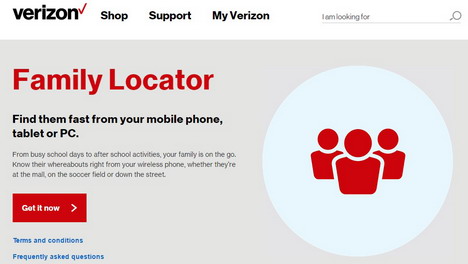
Cellphone companies bank on family plans. They understand that parents who want to have their entire family on the same plan do so for the convenience of connectivity as well as for safety. This is why every major American telecom provider has developed their own version of location sharing apps aimed at families.
2. iSharing – Family Location Tracking App for Free
iSharing is a GPS‑based location sharing and family safety app that lets family members and close friends privately share their real-time location.
- Real‑time tracking & map view: iSharing shows exact and live GPS locations on interactive maps (with optional Street View), which helps you see where loved ones are at any moment.
- Alerts & safety features: You can set up “place alerts” to get notifications when someone arrives or leaves a certain location, and there’s an SOS / panic alert for emergencies.
- Location history: iSharing offers a location history feature – up to 1 year in the premium plan – allowing you to look back at where people have been.
- Extra useful features: For families, it supports tracking multiple devices under one account, phone‑finder for lost devices, driving reports (useful if you want to monitor driving habits), and messaging inside the app.
3. X.com
The popular microblogging app X.com allows users to set location tags as precise as the neighbourhood they’re in when posting tweets. The app also saves data on the locations tweeted from for future use. Live videos made on Periscope can also serve to identify the broadcaster’s location in real time. Although this isn’t enough to pinpoint users on a map, the fact that this information is publicly displayed, and that Twitter collects data on user habits can be a security risk.
4. Foursquare Swarm
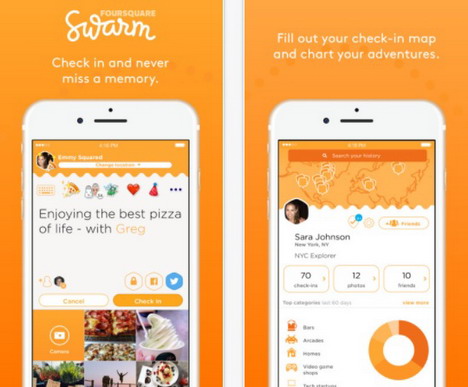
Foursquare launched in 2009 with the aim of providing location recommendations of users based on their recorded interests. The app allowed users to share their location by ‘checking in’ to restaurants, bars or places of interest with a map link. This function was later spun off and improved into the social media platform Swarm. Foursquare has been criticised for compromising user safety by publicly publishing their current location. Cross-linking a Foursquare or Swarm account with Facebook or Twitter can also leave users vulnerable to ‘stalker apps’.
5. Glympse
For those who are uneasy with Swarm’s lack of privacy, Glympse has the solution. Instead of permanently posting a user’s location, this app lets users share a glimpse of their lives with other users in a Snapchat style. Another interesting feature is the ability to create ‘circles’ containing close friends or family.
6. Life360 Family Locator
This app, which brands itself as part location, part communication targets parents who want keep tabs on their families. Family members are tracked in real-time, while the check-in button shows parents where their kids are on a private map. A special emergency button can be activated to instantly let the entire family know that there is a problem.
7. Find My Friends
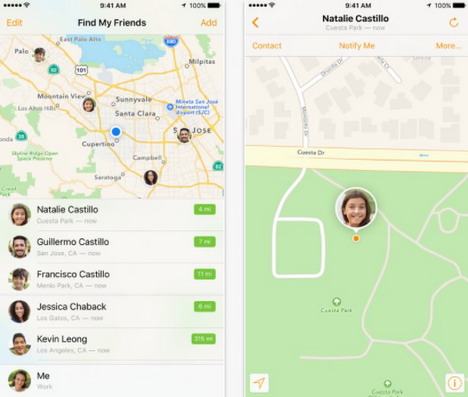
Apple makes use of its iCloud software to help users keep track of family and friends using their iPhones. Users are added to a list and need to accept to be tracked in order for the system to work. It’s based on the same technology that Apple introduced in order to help people find their lost or stolen i-Products. It’s a handy tool to have to keep track of loved ones, as long as the encryptions hold out.
8. Google Maps
The popular Google Maps app came with a real-time location sharing toggle when it first launched. After being discontinued for a while, it was quietly reintroduced this year. The app has been improved to let users share precise locations for a time period and with people of their choosing. Google Map’s 20 petabytes of data can be sourced to share locations, planned routes, and estimated times of arrival with multiple people in real time.
9. GeoZilla
GeoZilla is an app for real-time sharing location with friends and family. You can invite people into your family circle so they can see where each other are. You can also set up alerts when a family member leaves a location; receive notifications when a family member has arrived or left a location; and create geofences around specific locations and get alerts if anyone enters or exits these areas. You can also get reports of how many times your family has driven safely, and send messages quickly between members of your family using the in-app messaging system. You can also keep track of where your family was or what they did by looking at your location history. Geozilla has a very user-friendly interface and is compatible with other operating systems. It’s perfect for those who want to stay informed about the whereabouts of their families or small groups.
10. WhatsApp (Live Location)
Live Location on WhatsApp is a feature that allows users to share their present location in real-time with either an individual or a group chat for a specific time frame. Since the Live Location feature exists on WhatsApp, users do not need to go through any additional steps to activate this feature; therefore, it is quite simple to use as well as accessible. Users have the option of choosing how long they would like to share their real-time location, thus keeping them in control of when their Live Location appears to others and when it doesn’t.
Furthermore, when using Live Location on WhatsApp, updates are sent continuously, allowing others to track your location on a map as you move. This feature is often used for coordinating where to meet someone, for tracking your travel from one point to another, or for ensuring your safety when travelling alone. Additionally, WhatsApp Live Location is protected via End-to-End encryption. Therefore, Live Location is secure, reliable and simple to use.
11. Telegram (Live Location)
Telegram provides users with the ability to share their location with contacts or groups through the use of Telegram’s Live Location function. This feature works with Telegram’s cloud-based messaging service and allows users to see a dynamic map that continually updates as they move. In addition to the continually updating dynamic map, the Live Locations feature also includes a “proximity alert” function that sends an alert to your contacts whenever you are in close proximity to another person who has shared their location with you, which is a unique feature not found in any other text-based messaging service. Users can turn off location sharing at any time, and therefore maintain complete control of their privacy. The Live Location feature is ideal for coordinating group events, meeting with friends, or enhancing travel safety when used in conjunction with Telegram’s robust security standards, use of multiple devices, and efficiently designed interface.
12. Facebook
The major social media apps we all use are built around location-sharing. Facebook has been a pioneer in this field. The app uses crowd-sourced data to map popular locations, rate attractions, manage check-ins and connect users. Facebook’s ‘Places’ location API has been applied to its entire suite of social media apps, including Instagram and Messenger, thus integrating them into the Facebook platform. Since a quarter of the World population is on Facebook, the app boasts of the ability to connect people, but sometimes, publicly sharing your location there isn’t very safe. The fact that Facebook knows us better than we know ourselves is downright creepy.
13. Yik Yak
This app is an attempt to solve the security problem inherent to location-sharing. Users can anonymously post about anything from their moods to their thoughts on a map, and interact with other ‘yakkers’ without disclosing personal information.
14. Tinder
The location-based social search mobile app which became (in)famous for disrupting the dating scene is more than what you think. The company has been using the same screen-swiping principles from its dating app to expand its interface into other social situations. Tinder can now be used to find friends or like-minded individuals based on location.

You May Also Like:
 20 Best Apps to Track & Share Real-Time GPS Location
 Top 15 Personal Safety Apps for Women
 25 Best Tools to Find Someone’s Location by Phone Number
 Top 12 Best iPad Instant Messaging Apps You Must Install
 Top 5 Websites for Sex Chat With Real Women (2025)
 6 iPhone / Android Apps to Avoid Traffic Jams
 10 Most Helpful WeChat App Tips & Tricks
 5 Best Safety Apps for Kids, Women and Old People
Tags: google maps, mobile app, smartphone